
Visual Theology – Galatians
The Visual Theology charts are designed to help you see the structure and movement of Scripture. They highlight patterns, contrasts, and developments that are often difficult to hold together when reading line by line.
These charts show the structure of the argument. The accompanying articles develop each part in full.
This approach follows a long tradition of visual teaching in the Church. The well-known charts of Clarence Larkin helped many grasp the broad outline of Scripture. In the same spirit, these charts aim to make visible what the Word of God is revealing.
Charts and teaching notes for the book of Galatians. Select a chart below to view the image and article.
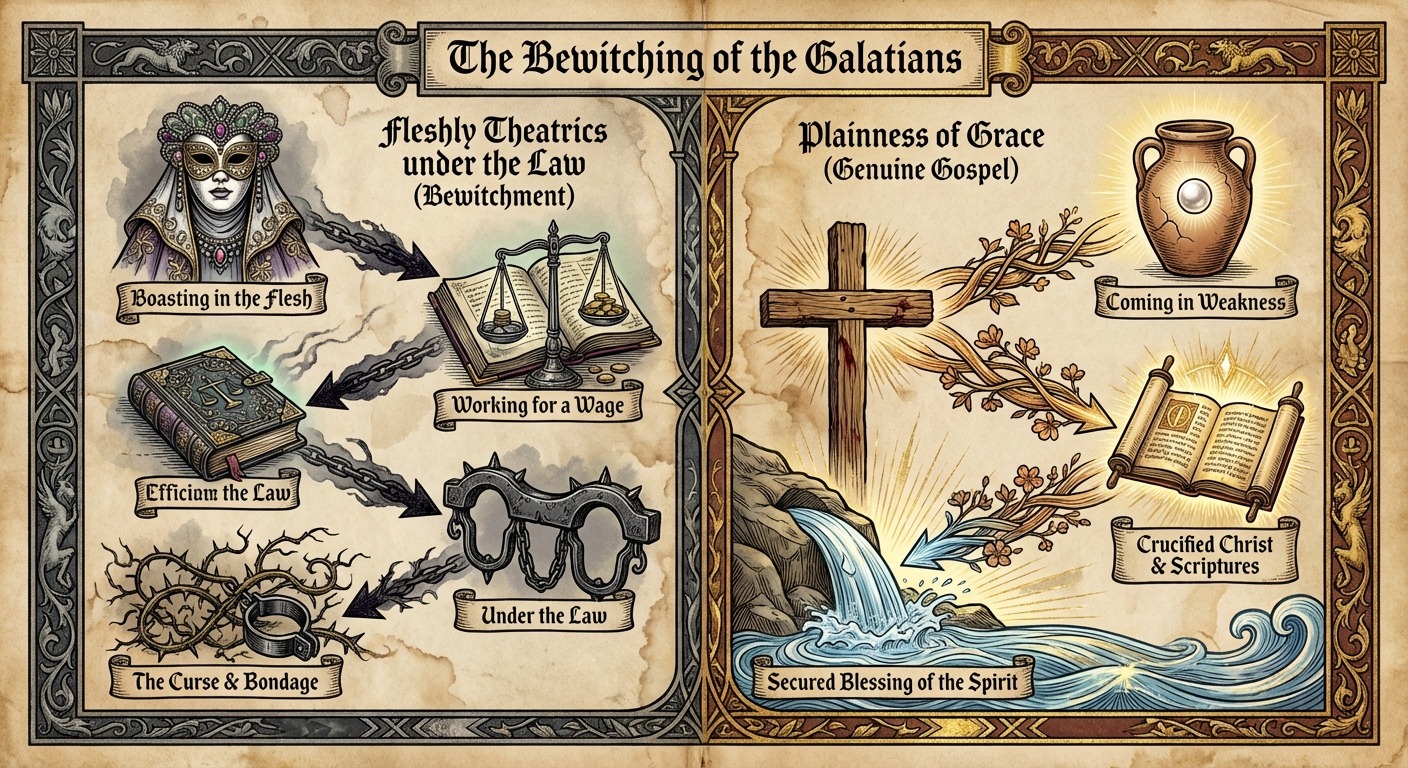
Click chart to view larger
From the teaching in: Galatians - Christ in Me As Life - the Spirit as the Blessing of the Gospel
Galatians 3:10
Fleshly Theatrics vs. Plain Grace
Galatians 3:10 -- Fleshly Theatrics vs. Plain Grace
This chart shows the structure. What follows explains each part.
Having just examined how spiritual bewitchment creates a false sense of lack to draw us from Christ's completeness, we now turn to the specific performance it demands. This article confronts the stark alternative: the 'fleshly theatrics' of law-keeping versus the 'plain grace' of the Gospel. Here, Paul dismantles the Judaizers' appeal to Abraham to expose their system as a burdensome, cursed performance, contrasting it sharply with the unadorned truth that justification comes by faith alone.
The Judaizers had Abraham on their side -- or so they thought. Abraham was the father of the faithful, the covenant-bearer, the one to whom circumcision was given as a sign of the relationship with God. If Paul's opponents could establish that Abraham's covenant was mediated through circumcision and law-keeping, then the requirement to bring Gentiles into that framework would be unassailable. Paul's counter-argument is one of the most elegant in the New Testament: Abraham was justified by faith, and the text says so, and the text was written four hundred and thirty years before there was a law to keep. The Judaizers' Abraham is a reading-back. Paul's Abraham is what the text actually says.
Galatians 3:10
For as many as are of the works of the law are under the curse: for it is written, Cursed is every one that continueth not in all things which are written in the book of the law to do them.
Theatrical Law vs. Plain Grace
In the epistle to the Galatians, Paul draws a sharp distinction between the religious showmanship that flourishes under the law and the unadorned truth of grace. The former is characterized by an elaborate display—boasting in the flesh and an appearance of power, as though donning a theatrical mask and glittering robes. This is not merely an outward matter; it reflects a deeper reliance on the works of the law, where justification is sought as a wage to be earned and recorded in the ornate ledger book of human effort, weighed out on the scale of merit (Galatians 3:1-3).
The Path of Bondage and Curse
This path, however, does not ascend to blessing. Instead, it leads into bondage. By putting oneself under the law—taking up the heavy iron yoke—one moves away from the liberty that is in Christ and into the realm of the curse (Galatians 5:1-4). The result is a withered, thorny vine and iron shackles: the experience of spiritual dryness, a loss of the sense of blessing, and the constriction of life under the law. Paul warns that those who seek to be justified by the law are “fallen from grace” and find themselves entangled in a system that cannot give life, but only exposes the futility of self-effort.
The True Ministry: Weakness and Power
In contrast, the true ministry of the Gospel comes not with outward pomp, but in weakness—a cracked, plain clay jar holding a radiant pearl (2 Corinthians 4:7). The precious truths of Christ are hidden in base things, without the trappings of religious spectacle. The focus is not on the flesh, but on the crucified Christ—the rough wooden cross, where all boasting is excluded except in His finished work (Galatians 6:14). This plainness is not emptiness, but the very power of God, for it directs the believer to search the Scriptures directly—the open, illuminated scroll—rather than relying on the traditions and performances that accompany the law.
The Secured Blessing of the Spirit
From this place, the believer is anchored into the flowing fountain of pure water: the secured blessing of the Spirit, received by faith and not by works (Galatians 3:13-14). The curse is bypassed entirely, for Christ has redeemed us from the curse of the law, being made a curse for us. Thus, the blessing of Abraham comes upon the Gentiles through Jesus Christ, and the promise of the Spirit is received by faith alone.
A Stark Contrast
The contrast is stark. On the one hand, fleshly theatrics under the law lead downward—first to pride and display, then to labor and bondage, and finally to curse and loss. On the other, the plainness of grace begins with humility and weakness, proceeds through the cross, and issues forth in the unmerited blessing of the Spirit. The believer is called not to put on a religious show, but to abide in the plain truth of the Gospel, where all sufficiency is found in Christ and the Spirit is given freely apart from works.
The theatrical apparatus of law-keeping -- the boasting, the curse, the bondage -- is now exposed against the plain simplicity of Abraham's faith: he believed God, and it was counted to him for righteousness. No performance. No circumcision at that point. Just faith in what God said. But the Galatians who were being drawn toward law were not doing so in a spirit of clear-eyed calculation -- they were being seduced, and Paul names it in the chapter's opening word: 'bewitched.' The article that follows examines that bewitchment and names what completeness in Christ looks like for those who have not been charmed away from it.
With the theatrical apparatus of law-keeping exposed as a path to curse and bondage, a pressing question remains: how, then, does the Christian life actually function day by day? The next article answers this by examining the precise mechanism—'the hearing of faith' versus 'the works of the law'—through which the Spirit is supplied and sustained in the believer.
Every chart in this series is free to explore online.
 Get the full chart set (PDF – $8)
Members get all PDFs included → Why Membership
Log in with an active membership to download printable PDFs on this site. Purchased on the shop? Access downloads from your shop account.
If you would like to help fund this work:
These charts are based on the following book:

Galatians - Christ in Me As Life - the Spirit as the Blessing of the Gospel
A biblical commentary on Galatians, exploring how Christ is revealed throughout Scripture. Deep theological insights for serious students of the Word.
View Related Book