
Visual Theology – Galatians
The Visual Theology charts are designed to help you see the structure and movement of Scripture. They highlight patterns, contrasts, and developments that are often difficult to hold together when reading line by line.
These charts show the structure of the argument. The accompanying articles develop each part in full.
This approach follows a long tradition of visual teaching in the Church. The well-known charts of Clarence Larkin helped many grasp the broad outline of Scripture. In the same spirit, these charts aim to make visible what the Word of God is revealing.
Charts and teaching notes for the book of Galatians. Select a chart below to view the image and article.
Click chart to view larger
From the teaching in: Galatians - Christ in Me As Life - the Spirit as the Blessing of the Gospel
Galatians 3:6-9
Waiting on the Promise by Faith
Galatians 3:6-9 -- Waiting on the Promise by Faith
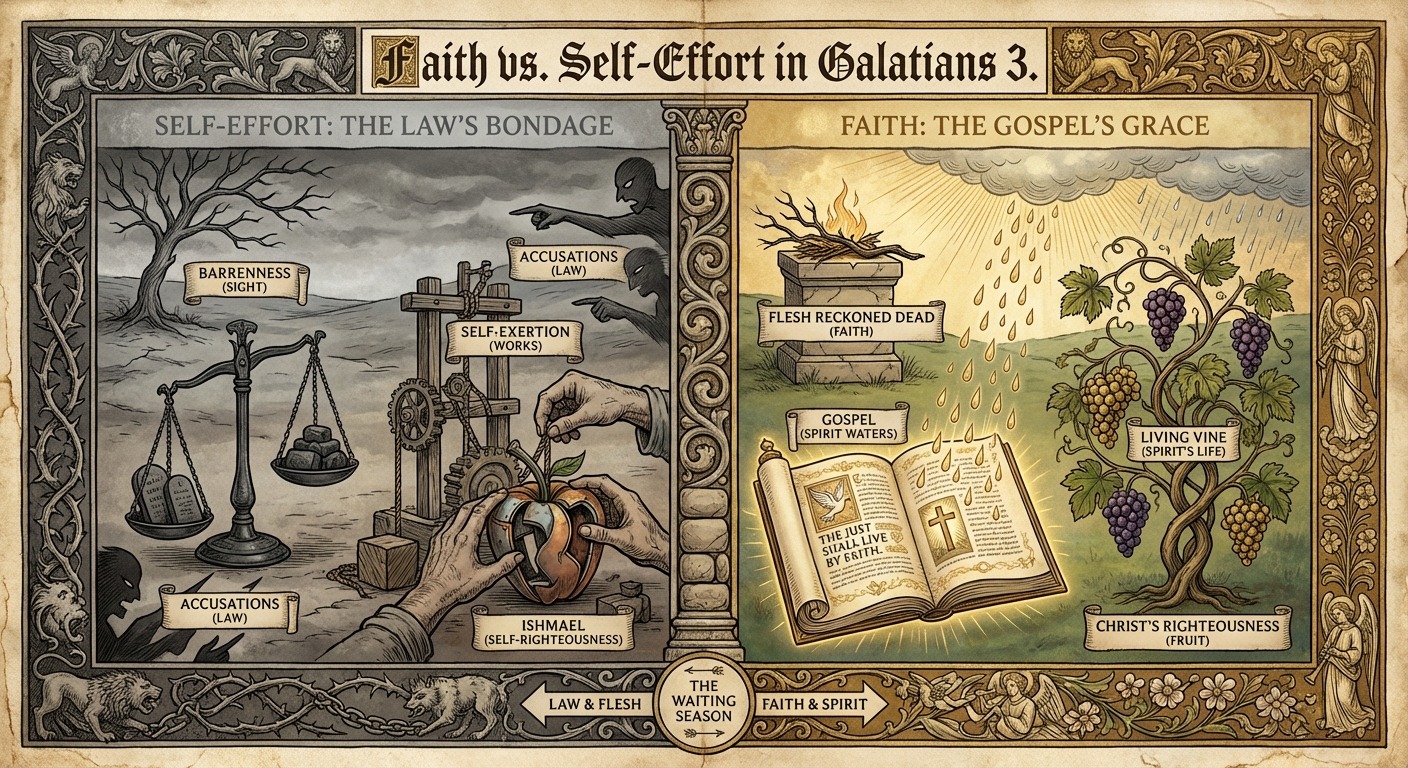
This chart shows the structure. What follows explains each part.
Having established that the Spirit is supplied through the hearing of faith, not the works of the law, Paul now anchors this truth in the foundational story of Abraham. This article moves from the principle of faith to its practical outworking in the most difficult season: the waiting period between promise and fulfillment. Here, the contrast between the two systems becomes a matter of daily posture—will we, like Abraham, wait on God's promise by faith, or will we, like Sarah and Abraham with Hagar, attempt to secure the blessing through fleshly effort?
The story of Abraham, Hagar, and Sarah is more than an Old Testament genealogical record -- it is, as Paul will make explicit in Galatians 4, an allegory of two covenants, two kinds of waiting, two kinds of receiving. Abraham heard the promise that he would have a son. He believed it. And then he waited. And in the waiting, the flesh had a suggestion: Hagar is available, the seed could come through her, you could have what God promised without waiting for God's timing. The Galatians were in the same moment -- they had the promise, they were waiting, and the Judaizers were offering them a version of Hagar: you could secure your inheritance by your own effort rather than waiting in faith.
Galatians 3:6-9
Even as Abraham believed God, and it was accounted to him for righteousness. Know ye therefore that they which are of faith, the same are the children of Abraham. And the scripture, foreseeing that God would justify the heathen through faith, preached before the gospel unto Abraham, saying, In thee shall all nations be blessed. So then they which be of faith are blessed with faithful Abraham.
Two Systems in the Waiting Season
The epistle to the Galatians sets before us two distinct systems by which a believer may respond to the waiting season: the false system of the flesh and the true system of faith. Paul exposes the mechanics of self-effort by which the believer, confronted with apparent barrenness—like a pruned, leafless tree in winter—turns inward and listens to the accusations from the Law and the enemy. These accusations, heavy as iron scales and shadowy as pointing fingers, press the believer to react by sight. Under this pressure, the flesh is stirred to activity, seeking relief and fruitfulness by law-keeping and self-exertion. The result is not the fruit of the Spirit, but the manufacture of an 'Ishmael' of self-righteousness: an artificial, mechanical product of human effort, not the living offspring of promise.
Paul addresses this in Galatians 3:2-3, asking, “Received ye the Spirit by the works of the law, or by the hearing of faith? Are ye so foolish? having begun in the Spirit, are ye now made perfect by the flesh?” The Galatians were tempted to supplement the Gospel with works, to complete in the flesh what was begun by the Spirit. This is the error of seeking to overcome barrenness by outward effort, striving to produce fruit by the energy of the old man. Such striving, however, only perpetuates the cycle of accusation and self-consciousness, for the Law cannot give life, but only reveal lack.
The True System of Faith
In contrast, the true system of faith is marked by the reckoning of the flesh as dead—a withered branch laid upon a stone altar. The believer ceases from striving, refusing to answer the accusations of the Law or the enemy with self-improvement or religious labor. Instead, he waits on God's promise, resting in the Gospel as an open, illuminated scroll receiving the rain from heaven. Here, the hearing of faith is the posture of the heart: “So then faith cometh by hearing, and hearing by the word of God” (Romans 10:17). The Spirit waters the inner life, not by human effort, but by the continual supply of Christ’s life received through faith.
This dynamic produces an unconscious, organic manifestation of Christ's righteousness—a living vine bearing fruit that is natural, not manufactured. Paul describes this in Galatians 2:20: “I am crucified with Christ: nevertheless I live; yet not I, but Christ liveth in me: and the life which I now live in the flesh I live by the faith of the Son of God, who loved me, and gave himself for me.” The believer is not striving to produce fruit for God, but is abiding in the promise, allowing the Spirit to bring forth the life of Christ within. The fruit is not the product of self-conscious labor, but the spontaneous outflow of a life watered by grace.
Ishmael and Isaac: The Allegory of Fruit
In the allegory of Galatians 4:21-31, Paul contrasts the child of the bondwoman, born after the flesh, with the child of the freewoman, born by promise. Those who turn to law-keeping and self-effort bring forth an 'Ishmael'—the result of human ingenuity and impatience. But those who wait on the promise, reckoning the flesh dead and resting in the Gospel, see the Spirit bring forth the true Isaac, the fruit of promise.
Thus, the life of Christ is not attained by law and effort, but is manifested as the believer stands in the place of death to self, attentive to the Gospel, and waits on God to fulfill His word. In the waiting season, the flesh is denied its activity, and the Spirit is given room to supply the life of Christ, producing fruit that is both real and lasting.
The Isaac pattern -- receiving the promise by faith through weakness, against all natural possibility -- is the exact shape of what Paul has been calling 'the hearing of faith' throughout this letter. The flesh seizes. Faith receives. And what faith receives is not a diminished version of the promise but the full inheritance, the very seed through whom the blessing of all nations flows. That seed has a name -- and it is the name that anchors the next article's argument about justification and the covenant of blessing: the Seed of Abraham, singular, is Christ.
Understanding the posture of faith in the waiting season prepares us for the next crucial question: what exactly is the nature of the promise we are waiting to receive? Paul will now trace the logic of justification back to its covenantal source in Abraham's singular Seed, showing how our union with Christ is the legal gateway to the very inheritance we receive by faith.
Every chart in this series is free to explore online.
 Get the full chart set (PDF – $8)
Members get all PDFs included → Why Membership
Log in with an active membership to download printable PDFs on this site. Purchased on the shop? Access downloads from your shop account.
If you would like to help fund this work:
These charts are based on the following book:

Galatians - Christ in Me As Life - the Spirit as the Blessing of the Gospel
A biblical commentary on Galatians, exploring how Christ is revealed throughout Scripture. Deep theological insights for serious students of the Word.
View Related Book