
Visual Theology – Galatians
The Visual Theology charts are designed to help you see the structure and movement of Scripture. They highlight patterns, contrasts, and developments that are often difficult to hold together when reading line by line.
These charts show the structure of the argument. The accompanying articles develop each part in full.
This approach follows a long tradition of visual teaching in the Church. The well-known charts of Clarence Larkin helped many grasp the broad outline of Scripture. In the same spirit, these charts aim to make visible what the Word of God is revealing.
Charts and teaching notes for the book of Galatians. Select a chart below to view the image and article.
Click chart to view larger
From the teaching in: Galatians - Christ in Me As Life - the Spirit as the Blessing of the Gospel
Galatians 2
The Trouble from Jerusalem vs. The Truth of Christ
Galatians 2 -- The Trouble from Jerusalem vs. The Truth of Christ
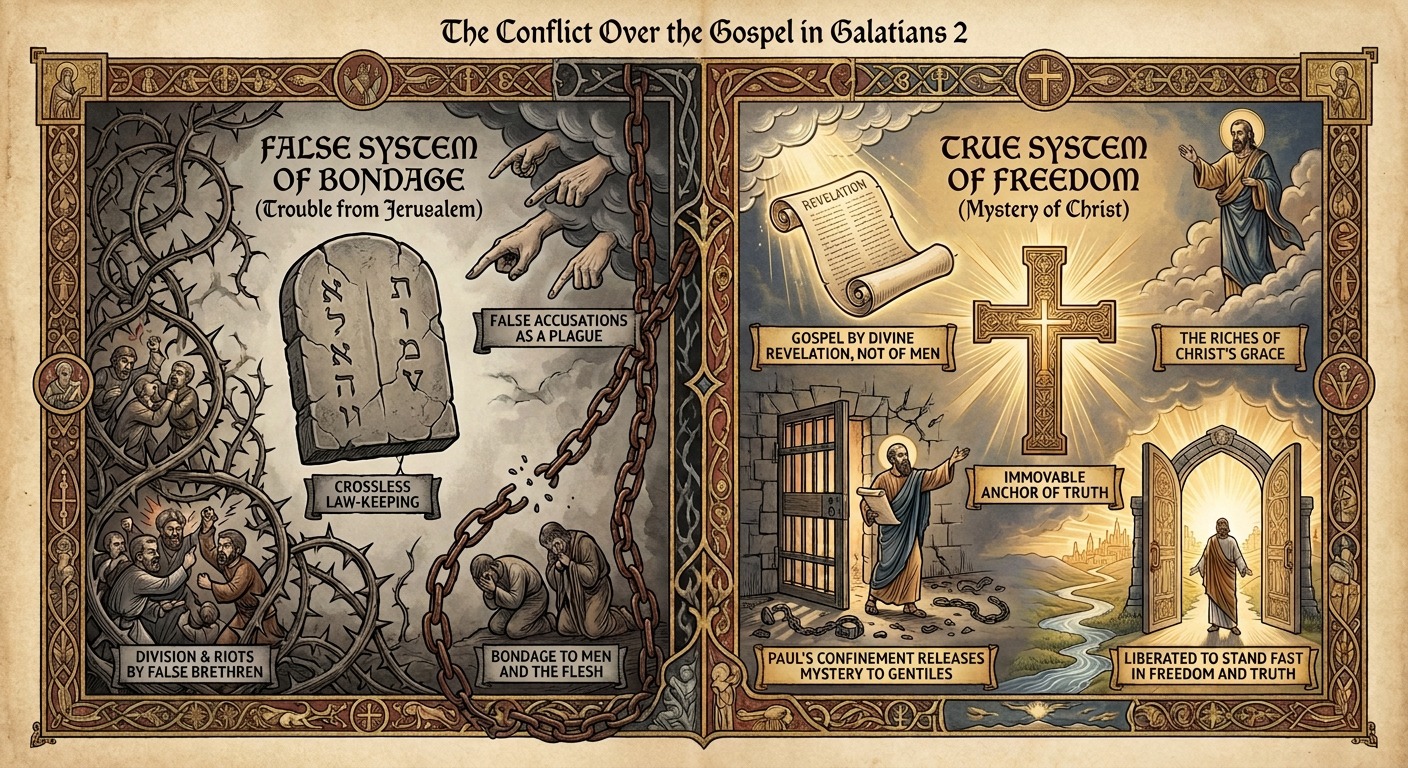
This chart shows the structure. What follows explains each part.
Having established the fundamental contrast between sanctification by faith and the religion of the flesh, we now turn to see how this theological conflict played out in a specific, explosive historical moment. This article examines 'The Trouble from Jerusalem vs. The Truth of Christ'—the practical collision between a gospel of pure grace and a system of religious mixture that threatened to enslave the early church. Here, the abstract principles of the previous chart become concrete in the Antioch confrontation, where the 'truth of the gospel' was visibly at stake in who shared a table.
The trouble from Jerusalem was not simply that certain men had wrong doctrine. It was that their influence produced a visible fracture at the place that should have been most symbolic of unity: the table. When Peter withdrew, Barnabas was carried away with the same dissimulation -- and Barnabas was Paul's companion, his fellow laborer, someone who had been through the conflict in Jerusalem and understood what was at stake. The infection was that serious. What Paul names when he says 'the truth of the gospel' is not a proposition but a lived reality -- and a reality that can be falsified by behavior even when the words remain orthodox. The article examines what the troublemakers from Jerusalem were actually offering, and why it was so effective.
Galatians 2
Then fourteen years after I went up again to Jerusalem with Barnabas, and took Titus with me also. And I went up by revelation, and communicated unto them that gospel which I preach among the Gentiles, but privately to them which were of reputation, lest by any means I should run, or had run, in vain. But neither Titus, who was with me, being a Greek, was compelled to be circumcised: and that because of false brethren unawares brought in, who came in privily to spy out our liberty which we have in Christ Jesus, that they might bring us into bondage: to whom we gave place by subjection, no, not for an hour; that the truth of the gospel might continue with you. But of these who seemed to be somewhat, whatsoever they were, it maketh no matter to me: God accepteth no man's person: for they who seemed to be somewhat in conference added nothing to me: but contrariwise, when they saw that the gospel of the uncircumcision was committed unto me, as the gospel of the circumcision was unto Peter; (for he that wrought effectually in Peter to the apostleship of the circumcision, the same was mighty in me toward the Gentiles:) and when James, Cephas, and John, who seemed to be pillars, perceived the grace that was given unto me, they gave to me and Barnabas the right hands of fellowship; that we should go unto the heathen, and they unto the circumcised. Only they would that we should remember the poor; the same which I also was forward to do.
The Antioch Confrontation: Truth Versus Bondage
Paul’s confrontation with Peter in Antioch, as recorded in Galatians 2:11-21, stands as a decisive moment in the early church, exposing the sharp contrast between the trouble from Jerusalem and the truth of Christ. At the heart of this conflict is the intrusion of religious mixture—a system of bondage that sought to impose crossless law-keeping on believers, drawing them back into servitude to men and the flesh.
The False System: Bondage and Religious Mixture
This false system is characterized by its heavy stone tablets, symbolizing the weight of commandments without the cross, and by tangled thorny vines, representing the division and unrest sown by false brethren. These false brethren, described in Galatians 2:4, “came in privily to spy out our liberty which we have in Christ Jesus, that they might bring us into bondage.” Their accusations and agitation framed the apostle Paul as a plague, seeking to undermine the revelation he received and the freedom he proclaimed. The result was the threat of heavy iron chains descending once more, binding the saints to ordinances and the approval of men, rather than to the living Christ.
The True System: Revelation and Freedom
In stark contrast, Paul sets forth the true system of freedom, rooted in the mystery of Christ. He insists in Galatians 1:11-12 that the gospel he preached is “not after man. For I neither received it of man, neither was I taught it, but by the revelation of Jesus Christ.” The open scroll descending from above signifies this direct divine revelation, unmediated by human tradition or religious authorities. Paul’s own experience of confinement—his being set apart and even opposed—became the means by which the full riches of the mystery of Christ were released to the Gentiles. The open prison door with shattered shackles declares that what was meant to confine instead became the occasion for the gospel’s liberation.
The Immovable Anchor: The Cross of Christ
At the center stands the sturdy, radiant cross, the immovable anchor of truth. It is only through Christ crucified that believers are delivered from the curse of the law and the bondage of religious mixture. Paul’s rebuke to Peter makes clear that to revert to law-keeping is to deny the sufficiency of Christ’s work. As he states, “I do not frustrate the grace of God: for if righteousness come by the law, then Christ is dead in vain” (Galatians 2:21, KJV).
The Call to Stand Fast in Liberty
The believer is thus called to “stand fast therefore in the liberty wherewith Christ hath made us free, and be not entangled again with the yoke of bondage” (Galatians 5:1). The open gateway leading out from the shadows pictures the believer’s call to remain in the freedom and truth of Christ, liberated from the religious mixture of men. The gospel is not a patchwork of law and grace, nor is it subject to the approval of those who would bring the saints back under bondage. Rather, it is the pure revelation of Christ, received from above, anchored in the cross, and opening the way for all who believe to walk in liberty and truth.
What the Antioch confrontation surfaces is a pattern that will recur throughout church history: the pressure to maintain respectability with the right institutional authority produces a withdrawal from the full gospel, often without anyone announcing that a withdrawal is happening. Peter did not stand up at Antioch and preach circumcision. He simply moved his chair. But the chair-moving told the Gentiles something. Paul refused to let it go unnamed. The next article goes deeper into that rebuke -- specifically what Paul said when he confronted Peter, and how the argument he made there becomes the pivot into the doctrinal heart of the letter.
This article has shown that the 'trouble from Jerusalem' was not a minor doctrinal dispute but a systemic threat to gospel liberty, manifesting in the tangible fracture of table fellowship. The confrontation at Antioch sets the stage for Paul's direct, public rebuke of Peter, which we will examine next. That rebuke will unpack what it means to 'walk uprightly according to the truth of the gospel'—showing how theology must be embodied in practice, not merely affirmed in theory.
Every chart in this series is free to explore online.
 Get the full chart set (PDF – $8)
Members get all PDFs included → Why Membership
Log in with an active membership to download printable PDFs on this site. Purchased on the shop? Access downloads from your shop account.
If you would like to help fund this work:
These charts are based on the following book:

Galatians - Christ in Me As Life - the Spirit as the Blessing of the Gospel
A biblical commentary on Galatians, exploring how Christ is revealed throughout Scripture. Deep theological insights for serious students of the Word.
View Related Book