
Visual Theology – Galatians
The Visual Theology charts are designed to help you see the structure and movement of Scripture. They highlight patterns, contrasts, and developments that are often difficult to hold together when reading line by line.
These charts show the structure of the argument. The accompanying articles develop each part in full.
This approach follows a long tradition of visual teaching in the Church. The well-known charts of Clarence Larkin helped many grasp the broad outline of Scripture. In the same spirit, these charts aim to make visible what the Word of God is revealing.
Charts and teaching notes for the book of Galatians. Select a chart below to view the image and article.
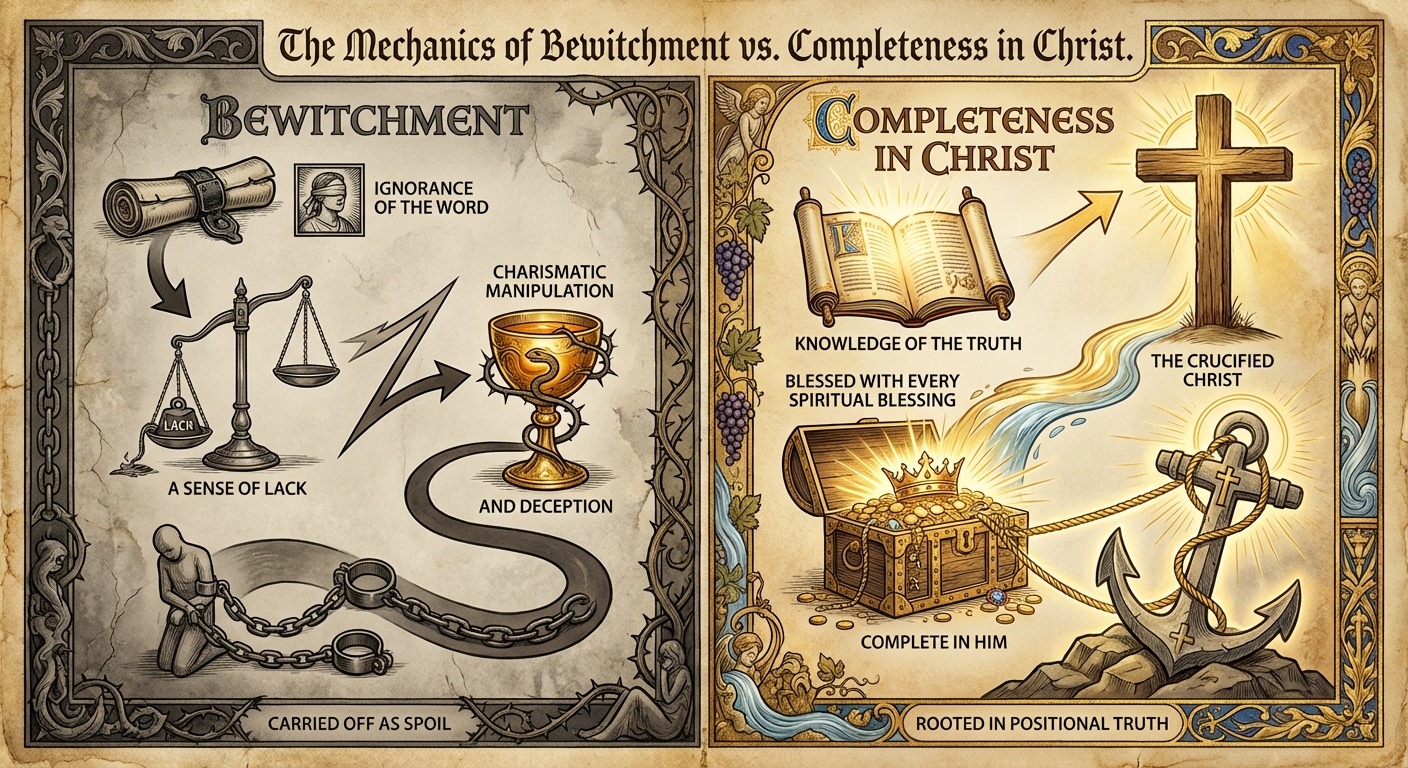
Click chart to view larger
From the teaching in: Galatians - Christ in Me As Life - the Spirit as the Blessing of the Gospel
Galatians Colossians 2:8-10
Bewitchment vs. Completeness
Galatians Colossians 2:8-10 -- Bewitchment vs. Completeness
This chart shows the structure. What follows explains each part.
Having established that the Spirit comes only through the hearing of faith—not through works—Paul now confronts the alarming consequence of abandoning that truth. If the Galatians received everything by faith, why are they now looking elsewhere? This article examines the spiritual condition Paul calls 'bewitchment,' where the clear truth of Christ crucified is obscured, creating a sense of lack that leads to bondage. Here, we see the deceptive mechanics that draw believers away from their completed position in Christ.
Paul opens Galatians 3 with a word that should arrest us: 'O foolish Galatians, who hath bewitched you?' The word translated 'bewitched' carries the sense of a spell cast over the eyes -- of people who have been made to not see what is right in front of them. The Galatians had seen Christ evidently set forth, crucified among them. The cross was not a rumor for them; it was a presented fact. And yet something -- or someone -- had managed to obscure it, to draw their attention away from the finished work toward something they still needed to accomplish. The article asks what the spell looks like, and what it means to break it.
Galatians Colossians 2:8-10
Beware lest any man spoil you through philosophy and vain deceit, after the tradition of men, after the rudiments of the world, and not after Christ. For in him dwelleth all the fulness of the Godhead bodily. And ye are complete in him, which is the head of all principality and power.
The Peril of Spiritual Bewitchment
The epistle to the Galatians warns of the peril of spiritual bewitchment, a condition in which believers, having begun in the Spirit, are drawn away from the sufficiency of Christ by persuasive deception. Galatians 3:1 addresses this directly: “O foolish Galatians, who hath bewitched you, that ye should not obey the truth...?” The mechanics of this bewitchment are rooted in a fundamental ignorance of the Word—a closed scroll, as it were—which leaves the believer vulnerable to error. This ignorance does not remain passive; it gives rise to a sense of lack, typified by unbalanced, empty scales. When the knowledge of the truth is absent, the heart perceives itself as deficient, always seeking what it imagines is missing.
Into this void steps the allure of charismatic manipulation and deception, represented as a golden cup filled with hidden thorns. The appearance is enticing, but the substance is injurious. Such manipulation capitalizes on the believer’s sense of lack, offering counterfeit solutions and experiences that promise to fill the perceived emptiness. The end of this progression is bondage: iron chains signify the believer carried off as spoil, no longer walking in the liberty of Christ but ensnared by false promises and doctrines.
The Antidote: Completeness in Christ
In contrast, the antidote to bewitchment is seeing that we are complete in Christ. This begins with an open, illuminated scroll—knowledge of the truth. The believer who is grounded in the Word does not look elsewhere for sufficiency, for the revelation of the crucified Christ stands at the center: “I am crucified with Christ: nevertheless I live; yet not I, but Christ liveth in me” (Galatians 2:20). The cross is not merely the entry point of the Christian life but the ongoing ground of our completeness.
From this foundation flows every spiritual blessing. The imagery of an overflowing treasure chest and a royal crown captures the abundance and honor bestowed upon those who are in Christ. As Ephesians 1:3 declares, “Blessed be the God and Father of our Lord Jesus Christ, who hath blessed us with all spiritual blessings in heavenly places in Christ.” There is no deficiency for those who are “complete in him, which is the head of all principality and power” (Colossians 2:10).
The Security of Positional Truth
This completeness is not a fleeting experience but a positional reality, securely fastened to a massive stone anchor—rooted in positional truth. To be rooted is to be immovable, unaffected by the shifting winds of doctrine or the enticements of spiritual novelty. The knowledge of our position in Christ is the believer’s sure protection. When the heart rests in what God has accomplished in Christ, the schemes of manipulation and the sense of lack lose their power. The open scroll, the cross, the overflowing blessings, and the anchor of positional truth together form an unbreakable chain of security for the believer.
Thus, the protection against spiritual bewitchment is not found in striving for more but in seeing and resting in the completeness that is already ours in Christ. The believer’s defense is the knowledge of the truth, the centrality of the crucified Christ, and the unshakable certainty of being blessed with every spiritual blessing—rooted and anchored in positional truth.
Completeness in Christ is not a destination you arrive at after sufficient effort -- it is the starting point of everything the gospel announces. You are complete in him. The bewitchment is the lie that you are not yet complete, that something more is required to close the gap, that the open scroll needs another seal before it can be trusted. Having established what completeness in Christ looks like and what its counterfeits cost, Paul now moves to the mechanism that actually delivers it -- and revisits co-crucifixion one more time, this time through the lens of what the cross accomplished for the law's authority over the believer.
Understanding our completeness in Christ is the only defense against bewitchment. But what does the alternative path actually look like when put into practice? The next article will expose the stark contrast between the theatrical performance of religious law-keeping and the plain, unadorned reality of living by grace alone.
Every chart in this series is free to explore online.
 Get the full chart set (PDF – $8)
Members get all PDFs included → Why Membership
Log in with an active membership to download printable PDFs on this site. Purchased on the shop? Access downloads from your shop account.
If you would like to help fund this work:
These charts are based on the following book:

Galatians - Christ in Me As Life - the Spirit as the Blessing of the Gospel
A biblical commentary on Galatians, exploring how Christ is revealed throughout Scripture. Deep theological insights for serious students of the Word.
View Related Book