
Visual Theology – Galatians
The Visual Theology charts are designed to help you see the structure and movement of Scripture. They highlight patterns, contrasts, and developments that are often difficult to hold together when reading line by line.
These charts show the structure of the argument. The accompanying articles develop each part in full.
This approach follows a long tradition of visual teaching in the Church. The well-known charts of Clarence Larkin helped many grasp the broad outline of Scripture. In the same spirit, these charts aim to make visible what the Word of God is revealing.
Charts and teaching notes for the book of Galatians. Select a chart below to view the image and article.
Click chart to view larger
From the teaching in: Galatians - Christ in Me As Life - the Spirit as the Blessing of the Gospel
Galatians 1:6-9
Introduction and Overview of Galatians
Galatians 1:6-9 -- Introduction and Overview of Galatians
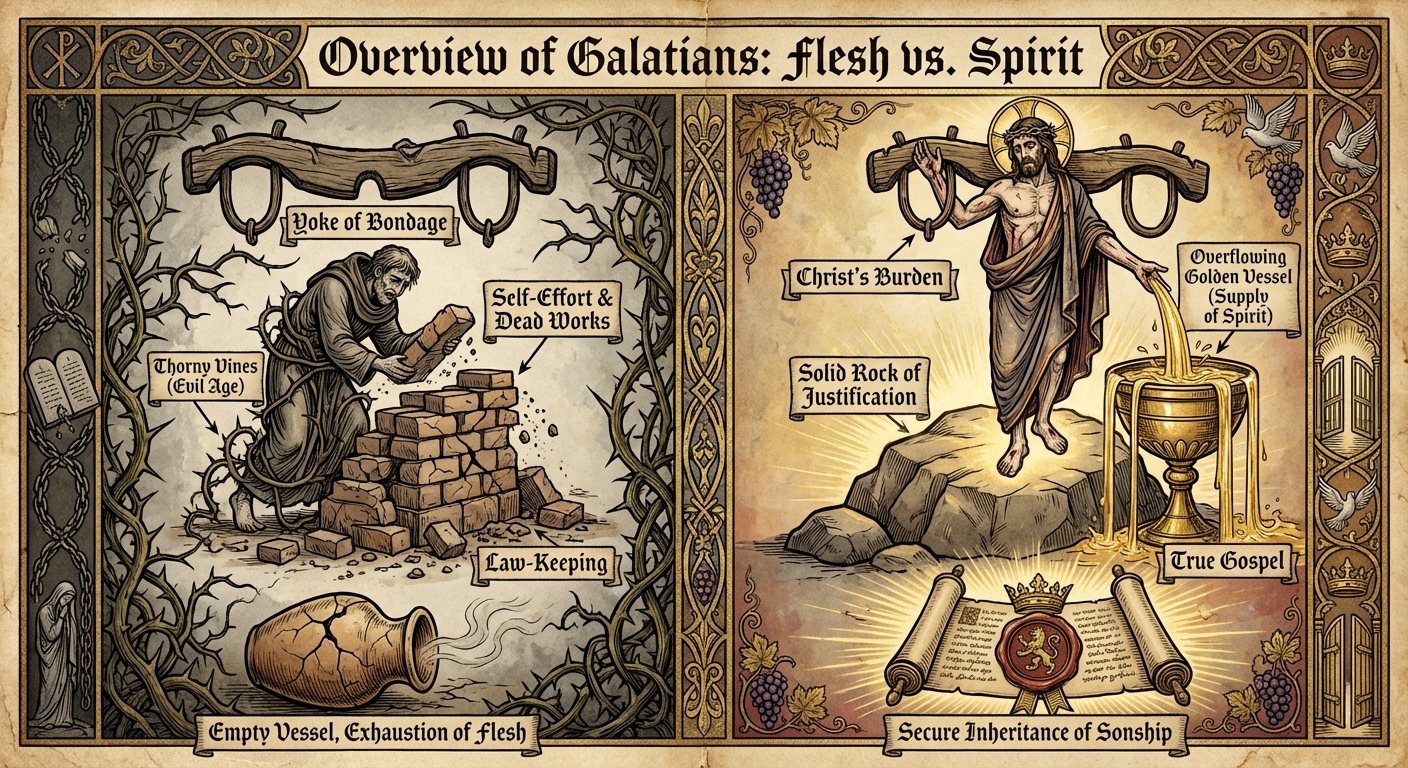
This chart shows the structure. What follows explains each part.
This first chart confronts us with the crisis that ignited Paul's letter: the Galatians were abandoning the true gospel for a counterfeit system of religious effort. Paul's opening salvo in Galatians 1:6-9 establishes the stark choice between two irreconcilable realities—exhausting human striving versus the liberating supply of Christ. As we begin this series, we must feel the weight of his warning: to add anything to Christ's finished work is not merely unnecessary, but a direct contradiction of the gospel itself.
Every letter Paul wrote was written against something -- and Galatians is no exception. The something here is a crisis so serious that Paul opens without a word of thanksgiving, moving immediately to astonishment and warning. What is at stake is not a secondary doctrine or a disputed practice; it is the very nature of the gospel itself. This book walks that crisis chart by chart, tracing the argument Paul builds from the ground up -- who gave him the message, what the message actually is, why it cannot be mixed with anything else, and what it looks like when a person actually lives inside it. Before you read what the article establishes, it helps to feel what is riding on the question: if Paul is right, then everything the Galatians were being told to add to Christ is not merely unnecessary -- it is a contradiction of Him.
Galatians 1:6-9
I marvel that ye are so soon removed from him that called you into the grace of Christ unto another gospel which is not another but there be some that trouble you and would pervert the gospel of Christ but though we or an angel from heaven preach any other gospel unto you than that which we have preached unto you let him be accursed as we said before so say I now again if any man preach any other gospel unto you than that ye have received let him be accursed
The Two Systems in Galatians
The epistle to the Galatians opens with a solemn warning against departing from the Gospel of Christ to embrace a different message, which Paul identifies as no gospel at all (Galatians 1:6-9). At the heart of the letter is a confrontation between two systems: the Galatian Error, characterized by striving in the flesh, and the True Gospel, summed up in the phrase, "Not I, but Christ." This contrast defines the spiritual battleground for the believer.
The Galatian Error: Striving in the Flesh
Under the false system of religious effort, the believer is pictured as beginning under a heavy wooden yoke of bondage. This yoke is the burden of law-keeping, a return to the principle of earning favor with God through the works of the flesh. Paul rebukes the Galatians for submitting themselves again to this bondage, declaring, "Stand fast therefore in the liberty wherewith Christ hath made us free, and be not entangled again with the yoke of bondage" (Galatians 5:1). The attempt to build an altar out of one's own crumbling bricks—self-effort and dead works—leads only to frustration and spiritual barrenness. The believer, entangled in thorny vines representing the present evil age, finds themselves drained and empty, holding a dry vessel that cannot satisfy the soul. This is the exhaustion of the flesh, the inevitable result of seeking righteousness by human strength.
The True Gospel: "Not I, but Christ"
In sharp contrast stands the True Gospel. Here, the believer is set upon the solid rock of justification, a foundation not laid by human hands but established by Christ's finished work. The burden of the law, with its impossible demands, is transferred entirely to the shoulders of a majestic, scarred Shepherd. Christ Himself bears the weight, fulfilling the law on behalf of the believer. Paul testifies, "I am crucified with Christ: nevertheless I live; yet not I, but Christ liveth in me" (Galatians 2:20). The life of the believer is no longer the product of striving in the flesh, but the manifestation of Christ's indwelling presence.
This new position brings with it an overflowing golden vessel—the continuous supply of the Spirit. No longer dry and empty, the believer receives the Spirit by the hearing of faith, not by the works of the law (Galatians 3:2-3). The supply is abundant and unceasing, sourced in Christ's sufficiency rather than human effort. Furthermore, the believer holds an open scroll with a royal wax seal, signifying the secure inheritance of sonship. Through faith in Christ, the believer is no longer a servant but a son, and if a son, then an heir of God through Christ.
The Call to Liberty
The Galatian Error thus stands exposed as a system of futility, leading only to exhaustion and emptiness, while the True Gospel proclaims liberty, supply, and assurance in the person and work of Christ. The message of Galatians calls every believer to renounce the yoke of bondage and to rest upon the solid rock of justification, to receive the overflowing supply of the Spirit, and to rejoice in the secure inheritance of sonship, all grounded in the reality of "Not I, but Christ."
What this opening chart establishes is the shape of the entire argument: two systems, mutually exclusive, producing opposite results -- one the exhaustion of the flesh trying to reach God by its own scaffolding, the other the overflowing supply of the Spirit received through the hearing of faith. The yoke is real. So is the liberty. But before Paul can press the case for one over the other, a prior question has to be settled -- where did this gospel come from, and why should anyone receive it over the message already circulating from Jerusalem? That question is where the letter begins.
Having established the two opposing systems at the heart of the Galatian crisis, a critical question naturally arises: who gets to define the true gospel? This leads us directly to Paul's next point, where he defends the divine origin of his message against all human approval. The authority of the messenger is inseparable from the purity of the message he brings.
Every chart in this series is free to explore online.
 Get the full chart set (PDF – $8)
Members get all PDFs included → Why Membership
Log in with an active membership to download printable PDFs on this site. Purchased on the shop? Access downloads from your shop account.
If you would like to help fund this work:
These charts are based on the following book:

Galatians - Christ in Me As Life - the Spirit as the Blessing of the Gospel
A biblical commentary on Galatians, exploring how Christ is revealed throughout Scripture. Deep theological insights for serious students of the Word.
View Related Book