
Visual Theology – Galatians
The Visual Theology charts are designed to help you see the structure and movement of Scripture. They highlight patterns, contrasts, and developments that are often difficult to hold together when reading line by line.
These charts show the structure of the argument. The accompanying articles develop each part in full.
This approach follows a long tradition of visual teaching in the Church. The well-known charts of Clarence Larkin helped many grasp the broad outline of Scripture. In the same spirit, these charts aim to make visible what the Word of God is revealing.
Charts and teaching notes for the book of Galatians. Select a chart below to view the image and article.
Click chart to view larger
From the teaching in: Galatians - Christ in Me As Life - the Spirit as the Blessing of the Gospel
Galatians 2:1-14
Paul's Rebuke of Peter and the Truth of the Gospel
Galatians 2:1-14 -- Paul's Rebuke of Peter and the Truth of the Gospel
This chart shows the structure. What follows explains each part.
Having established the fundamental conflict between Law and Grace, we now witness this conflict play out in a dramatic, personal confrontation. The previous article exposed the theoretical error of mixing these two systems; here we see that error embodied in the actions of an apostle. Paul's public rebuke of Peter at Antioch demonstrates that compromising the truth of the Gospel is not an abstract theological misstep, but a practical denial of liberty with immediate, damaging consequences for the entire church.
The confrontation at Antioch is one of the most revealing moments in the New Testament -- not because it exposes Peter as a hypocrite, but because it exposes how subtly the gospel can be contradicted by behavior even when the theology is correct. Peter knew the truth. He had already received the vision of the sheet, had already visited Cornelius's house, had already declared that God makes no distinction. And yet when certain men came from James, he withdrew and separated himself from the Gentile believers -- not because his doctrine had changed, but because he feared them which were of the circumcision. Paul saw immediately that the behavior implied a gospel. And the gospel it implied was false.
Galatians 2:1-14
Then fourteen years after I went up again to Jerusalem with Barnabas, and took Titus with me also. And I went up by revelation, and communicated unto them that gospel which I preach among the Gentiles, but privately to them which were of reputation, lest by any means I should run, or had run, in vain. But neither Titus, who was with me, being a Greek, was compelled to be circumcised: and that because of false brethren unawares brought in, who came in privily to spy out our liberty which we have in Christ Jesus, that they might bring us into bondage; to whom we gave place by subjection, no, not for an hour; that the truth of the gospel might continue with you. But of these who seemed to be somewhat, whatsoever they were, it maketh no matter to me: God accepteth no man's person: for they who seemed to be somewhat in conference added nothing to me: but contrariwise, when they saw that the gospel of the uncircumcision was committed unto me, as the gospel of the circumcision was unto Peter; for he that wrought effectually in Peter to the apostleship of the circumcision, the same was mighty in me toward the Gentiles: and when James, Cephas, and John, who seemed to be pillars, perceived the grace that was given unto me, they gave to me and Barnabas the right hands of fellowship; that we should go unto the heathen, and they unto the circumcised. Only they would that we should remember the poor; the same which I also was forward to do. But when Peter was come to Antioch, I withstood him to the face, because he was to be blamed. For before that certain came from James, he did eat with the Gentiles: but when they were come, he withdrew and separated himself, fearing them which were of the circumcision. And the other Jews dissembled likewise with him; insomuch that Barnabas also was carried away with their dissimulation. But when I saw that they walked not uprightly according to the truth of the gospel, I said unto Peter before them all, If thou, being a Jew, livest after the manner of Gentiles, and not as do the Jews, why compelest thou the Gentiles to live as do the Jews?
The Peril of Mixing Law and Grace
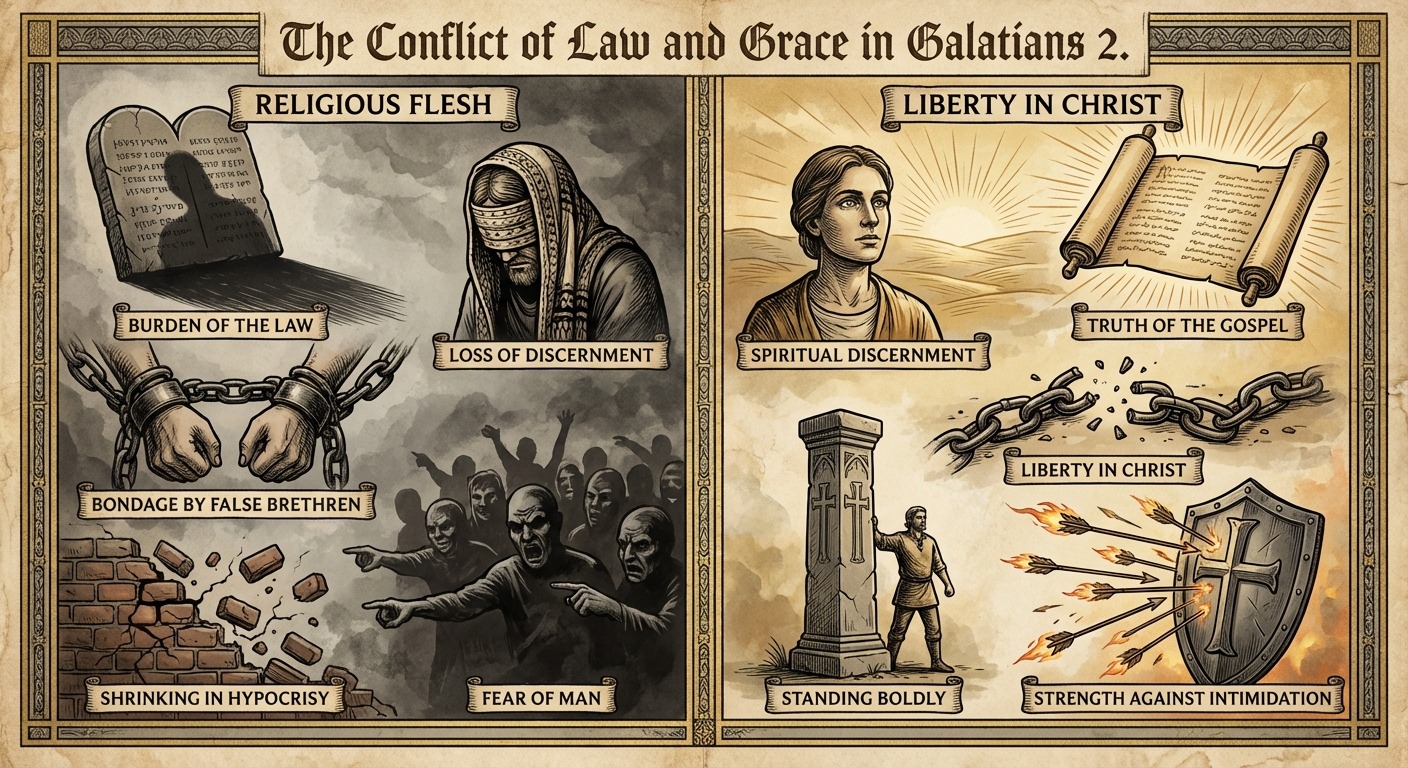
Paul’s confrontation with Peter in Antioch, as recorded in Galatians 2:11-21, brings into sharp relief the peril of mixing Law and Grace and the vital necessity of walking in the truth of the Gospel. When Peter, influenced by certain men from James, withdrew from eating with Gentile believers, he did not merely display personal inconsistency; rather, he was drawn into the mechanics of religious flesh. This action cast a long, oppressive shadow—the burden of the law falling once more upon those who had been set free in Christ.
The Old System: Bondage and the Veil
Under this old system, the law stands as heavy stone tablets, imposing and unyielding, pressing down upon the conscience and obscuring the liberty given in Christ. The result is a thick, woven veil covering the eyes, a loss of spiritual discernment that blinds even the most sincere believer to the reality of the Gospel. Paul identifies this loss in Galatians 2:14, declaring, "But when I saw that they walked not uprightly according to the truth of the gospel, I said unto Peter before them all..." The truth of the Gospel is not compatible with the shadow of the law, for the law veils the eyes and keeps men from beholding the liberty that is in Christ.
Further, the religious flesh brings believers into bondage through the influence of false brethren. Galatians 2:4 speaks of "false brethren unawares brought in, who came in privily to spy out our liberty which we have in Christ Jesus, that they might bring us into bondage." The chains of legalism are not merely external regulations but spiritual shackles that bind the hands and hinder the walk of faith. The presence of a menacing crowd, pointing condemning fingers, reveals the underlying fear of man and the pressure to conform to religious expectations. This fear leads to hypocrisy, as seen when Peter and even Barnabas were carried away with dissimulation (Galatians 2:13). The crumbling wall of hypocrisy is the inevitable result of shrinking back from the liberty of the Gospel, retreating into the safety of outward forms while the truth is compromised.
The New System: Liberty and Discernment
In stark contrast, the new system of Liberty in Christ is characterized by the open scroll radiating warm light—the Truth of the Gospel shining unhindered. Where the law veiled the eyes, the Gospel brings clear, unveiled sight, granting spiritual discernment and the ability to see the horizon of God’s purpose. The chains of bondage are shattered, lying in the dust, as believers stand in the liberty wherewith Christ has made them free (Galatians 5:1). No longer subject to the intimidation of religious flesh or the fear of man, the believer is called to stand firm and upright, as a stone pillar unmoved by the shifting winds of opinion or tradition.
A Defense of the Gospel’s Essence
Paul’s rebuke of Peter is not merely a correction of personal conduct but a defense of the very essence of the Gospel. To mix Law and Grace is to obscure the truth, to surrender liberty for bondage, and to exchange the boldness of faith for the shrinking timidity of hypocrisy. Only by walking in the truth of the Gospel can one possess spiritual discernment, stand boldly against the intimidation of religious flesh, and enjoy the full liberty that is in Christ Jesus. As Paul testifies, "I do not frustrate the grace of God: for if righteousness come by the law, then Christ is dead in vain" (Galatians 2:21).
Paul's rebuke of Peter at Antioch is not a personal dispute -- it is a public exposition of what is always at stake when behavior at the table communicates something the cross has denied. If Peter's withdrawal implied that Gentiles must live as Jews to be fully accepted, then Christ's death was insufficient, and the gospel Paul preached was empty. The logic is inexorable: either Christ's work is complete and the Gentile believer stands before God with exactly the same standing as the Jewish believer, or it is not complete and everyone must supplement it with something else. There is no third option. The next article examines what it means to be sanctified by faith rather than by the religion of the flesh -- what the life on the grace side of that rebuke actually looks like.
Paul's confrontation with Peter starkly illustrates that the Gospel's truth must govern our behavior, not just our beliefs. This incident sets the stage for a crucial question: if sanctification is not achieved through the religious performance Peter momentarily embraced, then what is the positive alternative? Our next article will unpack the contrast between the hollow imitation produced by the flesh and the genuine life that flows from faith alone.
Every chart in this series is free to explore online.
 Get the full chart set (PDF – $8)
Members get all PDFs included → Why Membership
Log in with an active membership to download printable PDFs on this site. Purchased on the shop? Access downloads from your shop account.
If you would like to help fund this work:
These charts are based on the following book:

Galatians - Christ in Me As Life - the Spirit as the Blessing of the Gospel
A biblical commentary on Galatians, exploring how Christ is revealed throughout Scripture. Deep theological insights for serious students of the Word.
View Related Book