
Visual Theology – Galatians
The Visual Theology charts are designed to help you see the structure and movement of Scripture. They highlight patterns, contrasts, and developments that are often difficult to hold together when reading line by line.
These charts show the structure of the argument. The accompanying articles develop each part in full.
This approach follows a long tradition of visual teaching in the Church. The well-known charts of Clarence Larkin helped many grasp the broad outline of Scripture. In the same spirit, these charts aim to make visible what the Word of God is revealing.
Charts and teaching notes for the book of Galatians. Select a chart below to view the image and article.
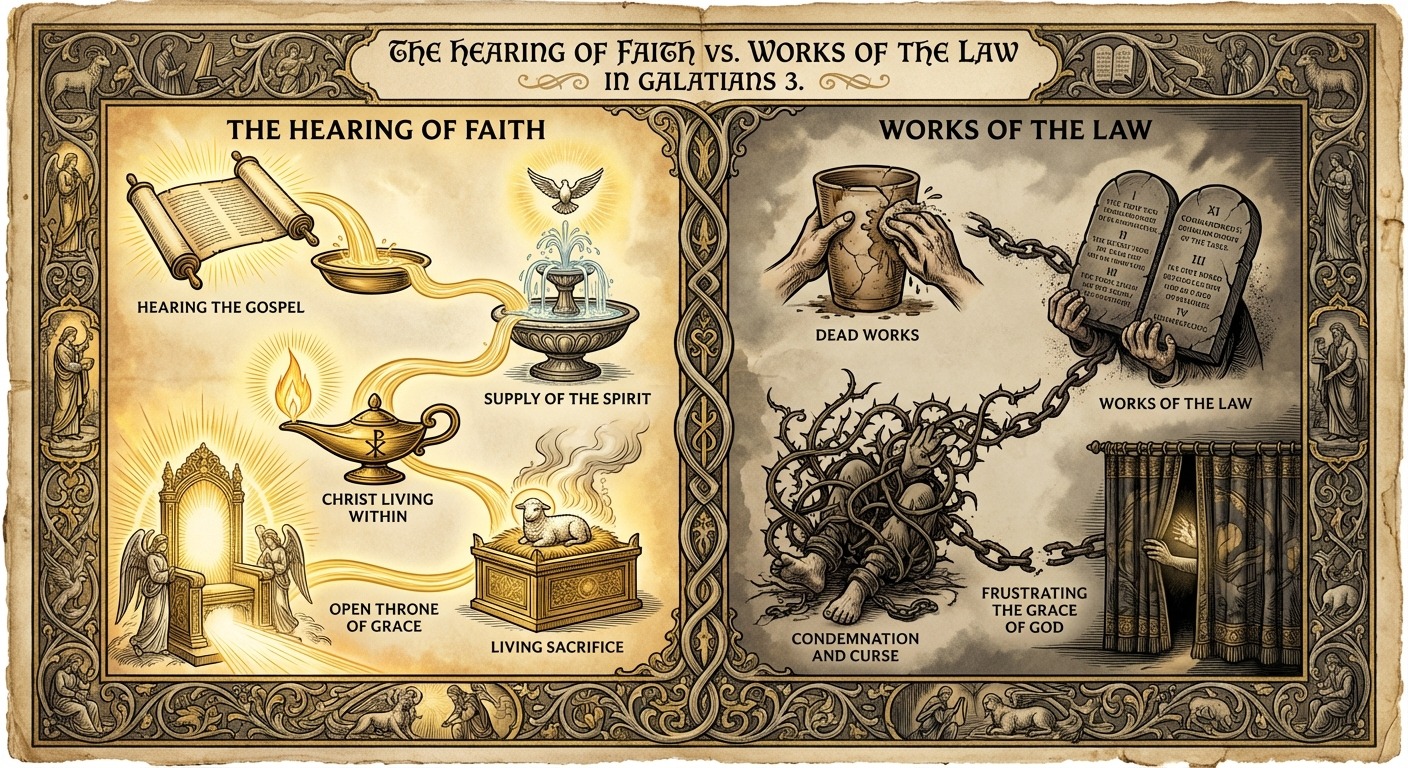
Click chart to view larger
From the teaching in: Galatians - Christ in Me As Life - the Spirit as the Blessing of the Gospel
Galatians 3:1-5
The Hearing of Faith vs. Works of the Law
Galatians 3:1-5 -- The Hearing of Faith vs. Works of the Law
This chart shows the structure. What follows explains each part.
Having established the fundamental mechanics of being crucified with Christ and living by His indwelling life, Paul now turns from theological declaration to experiential argument. In this article, we examine Galatians 3:1-5, where Paul confronts the Galatians with the undeniable evidence of their own spiritual history: the Spirit came through the hearing of faith, not through works of the law. This appeal to their lived experience powerfully demonstrates that the principle of faith governs not only our justification but the entire supply of the Christian life.
Paul's appeal in Galatians 3 is not to a theological treatise -- it is to the Galatians' own experience. He wants them to remember how the Spirit came. Not as a result of their obedience to the Mosaic code. Not as a reward for circumcision or Sabbath-keeping or dietary faithfulness. The Spirit came when they heard the gospel and believed it. That is the fact on the ground, and it is devastating to the Judaizers' case -- because if the Spirit came through the hearing of faith rather than the works of the law, then the works of the law cannot be the path to spiritual maturity any more than they were the path to spiritual birth.
Galatians 3:1-5
O foolish Galatians, who hath bewitched you, that ye should not obey the truth, before whose eyes Jesus Christ hath been evidently set forth, crucified among you? This only would I learn of you, Received ye the Spirit by the works of the law, or by the hearing of faith? Are ye so foolish? Having begun in the Spirit, are ye now made perfect by the flesh? Have ye suffered so many things in vain? if it be yet in vain. He therefore that ministereth to you the Spirit, and worketh miracles among you, doeth he it by the works of the law, or by the hearing of faith?
The Hearing of Faith vs. The Works of the Law
The epistle to the Galatians lays bare the profound difference between the hearing of faith and the works of the law as the basis for the believer’s life in Christ. Paul’s argument in Galatians 3:2-5 centers on the question, “Received ye the Spirit by the works of the law, or by the hearing of faith?” (Galatians 3:2, KJV). The answer is clear: it is by the hearing of faith that the believer receives the supply of the Spirit. This hearing is likened to the reception of an unrolled scroll, the Gospel itself, which is not merely information but the very means by which the Spirit is supplied to the believer.
The Inward Life of Faith
As the Spirit is supplied by faith, there is a flowing fountain set in motion within. This fountain is no mere external influence, but the living Christ within, igniting a burning lamp. Paul declares, “I am crucified with Christ: nevertheless I live; yet not I, but Christ liveth in me: and the life which I now live in the flesh I live by the faith of the Son of God, who loved me, and gave himself for me” (Galatians 2:20, KJV). The life of Christ in the believer is not the product of striving or self-effort, but the result of faith’s hearing and the Spirit’s inward supply.
This inward life issues in an unblemished offering, a living sacrifice presented upon a golden altar. The believer, thus animated by Christ’s life, is able to offer himself without spot, for it is not the energy of the flesh but the Spirit’s work. As Paul writes elsewhere, “I beseech you therefore, brethren, by the mercies of God, that ye present your bodies a living sacrifice, holy, acceptable unto God, which is your reasonable service” (Romans 12:1, KJV). Such a sacrifice is not hindered by guilt or distance, but enjoys unhindered access to the open Throne of Grace, as Hebrews 4:16 exhorts: “Let us therefore come boldly unto the throne of grace, that we may obtain mercy, and find grace to help in time of need.”
The Burden of the Law
In stark contrast, the works of the law offer only a system of dead works. Here, the hands labor to cleanse the outside of a dirty clay cup, but no inward transformation is effected. The law, far from supplying life, becomes a burden of heavy, crushing stone tablets. The one who seeks life by the works of the law becomes entangled in condemnation and curse, as Paul warns, “Christ is become of no effect unto you, whosoever of you are justified by the law; ye are fallen from grace” (Galatians 5:4, KJV). The result is not access, but a thick, impenetrable veil that frustrates the grace of God and leaves the soul in bondage.
Two Opposing Systems
Thus, the mechanics of the hearing of faith and the works of the law are not merely alternative methods, but opposing systems with entirely different outcomes. Faith unlocks the supply of the Spirit, resulting in Christ as life, living sacrifice, and open access to grace. The law, by contrast, brings only dead works, condemnation, and the frustration of grace. The epistle calls the believer to stand in the liberty of the hearing of faith, receiving the continual supply of the Spirit, and to refuse the yoke of bondage which the works of the law impose.
The hearing of faith versus the works of the law is not an abstract theological binary -- it is a question with a verifiable answer in every believer's own history. The Spirit came a particular way, and that way was not through legal performance. Having pressed that point through the Galatians' experience, Paul is about to press it through something older: Abraham. The patriarch was justified by faith four hundred and thirty years before the law existed. If faith was the operative mechanism at the very beginning of the covenant story, then the law's later arrival cannot have been intended to replace it. That is the argument the next article follows.
By grounding the Christian life in the hearing of faith rather than human effort, Paul has exposed the futility of returning to law-keeping. Yet, the Galatians were still vulnerable to a subtle deception that could draw them away from this truth. This leads us directly to the next article, which examines the nature of this spiritual bewitchment and the powerful antidote found in our completeness in Christ.
Every chart in this series is free to explore online.
 Get the full chart set (PDF – $8)
Members get all PDFs included → Why Membership
Log in with an active membership to download printable PDFs on this site. Purchased on the shop? Access downloads from your shop account.
If you would like to help fund this work:
These charts are based on the following book:

Galatians - Christ in Me As Life - the Spirit as the Blessing of the Gospel
A biblical commentary on Galatians, exploring how Christ is revealed throughout Scripture. Deep theological insights for serious students of the Word.
View Related Book