
Visual Theology – Galatians
The Visual Theology charts are designed to help you see the structure and movement of Scripture. They highlight patterns, contrasts, and developments that are often difficult to hold together when reading line by line.
These charts show the structure of the argument. The accompanying articles develop each part in full.
This approach follows a long tradition of visual teaching in the Church. The well-known charts of Clarence Larkin helped many grasp the broad outline of Scripture. In the same spirit, these charts aim to make visible what the Word of God is revealing.
Charts and teaching notes for the book of Galatians. Select a chart below to view the image and article.
Click chart to view larger
From the teaching in: Galatians - Christ in Me As Life - the Spirit as the Blessing of the Gospel
Galatians 3:15-18
The Unbreakable Covenant of the Seed
Galatians 3:15-18 -- The Unbreakable Covenant of the Seed
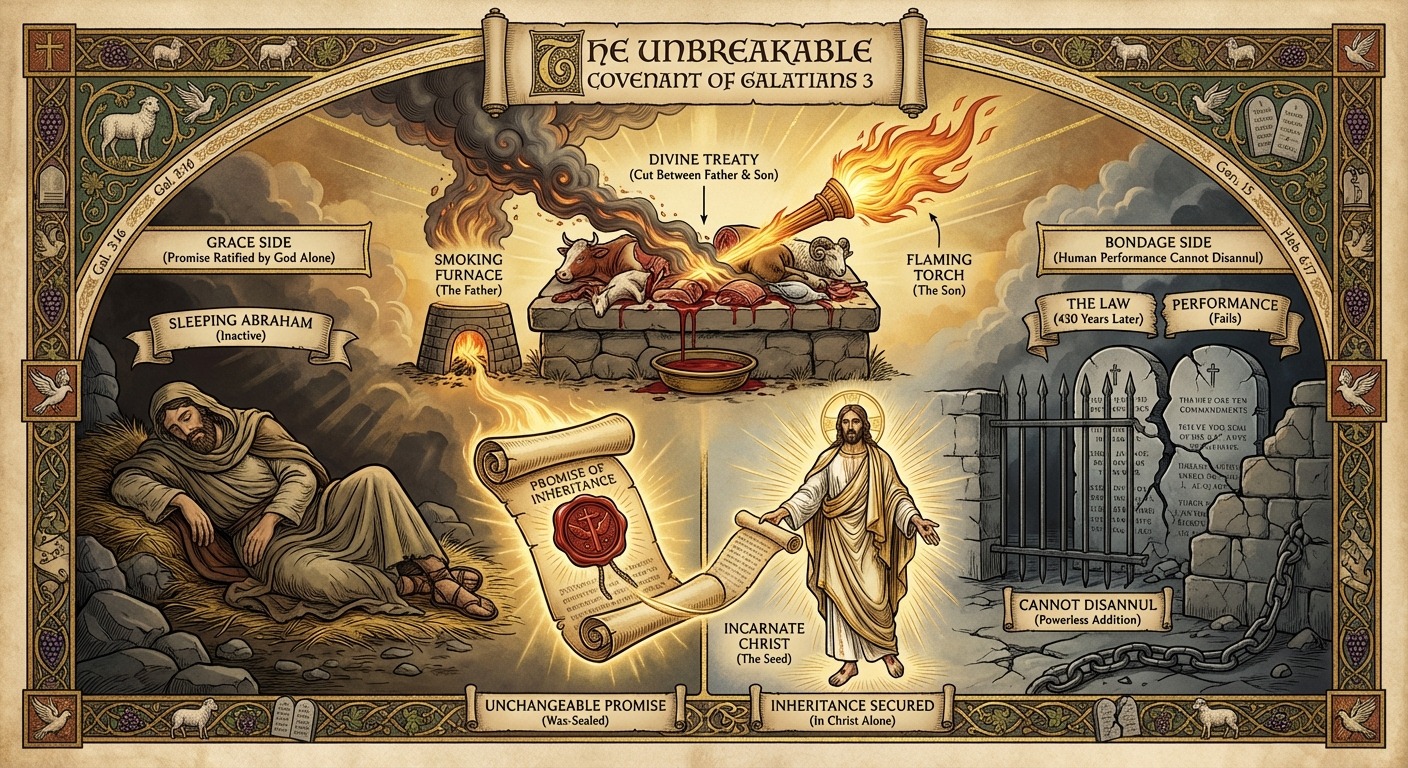
This chart shows the structure. What follows explains each part.
Having established the stark binary between justification by faith and justification by works, Paul now grounds that exclusive faith-path in something unshakable. This article examines the foundational bedrock of the gospel: the unilateral, unbreakable covenant God made with Abraham, which was ratified by God alone and promised to a singular Seed—Christ. Here, we see why the law, coming centuries later, cannot add conditions to or annul a promise that rests entirely on God's oath.
Genesis 15 is one of the most astonishing chapters in the Old Testament -- not for what Abraham did, but for what he did not do. When God made the covenant with Abraham, He caused a deep sleep to fall on the patriarch, and then He alone passed between the pieces. In ancient covenant ratification, both parties would walk between the pieces as a declaration that if either broke the covenant, they would be like those animals. But Abraham slept. Only God walked. This was a unilateral covenant -- a promise sealed not by mutual obligation but by God's own oath. Paul's argument in Galatians rests on this structure: the promise made to Abraham's Seed is unbreakable because it rests on God's faithfulness alone, not on the performance of the one who receives it.
Galatians 3:15-18
Brethren, I speak after the manner of men; Though it be but a man’s covenant, yet if it be confirmed, no man disannulleth, or addeth thereto. Now to Abraham and his seed were the promises made. He saith not, And to seeds, as of many; but as of one, And to thy seed, which is Christ. And this I say, that the covenant, that was confirmed before of God in Christ, the law, which was four hundred and thirty years after, cannot disannul, that it should make the promise of none effect. For if the inheritance be of the law, it is no more of promise: but God gave it to Abraham by promise.
The Abrahamic Covenant: A Unilateral Promise
The Abrahamic Covenant stands as a unilateral promise, its foundation laid entirely within the Godhead, apart from any human contribution or subsequent addition. This is first revealed in the scene of Genesis 15, where Abraham, the recipient of the promise, is rendered completely inactive—depicted as a sleeping figure removed from the decisive transaction. The divine parties alone, represented by the smoking furnace and the flaming torch, pass through the severed animal pieces upon the altar. This act signifies that the covenant is cut exclusively between the Father and the Son, with Abraham not as a participant but as a beneficiary. The arrangement thus established is not open to human negotiation or alteration; it is a sovereign act of God, ratified by Himself alone.
The Promise Made to the One Seed
Galatians 3:16-18 gives clear witness to this arrangement: "Now to Abraham and his seed were the promises made. He saith not, And to seeds, as of many; but as of one, And to thy seed, which is Christ. And this I say, that the covenant, that was confirmed before of God in Christ, the law, which was four hundred and thirty years after, cannot disannul, that it should make the promise of none effect. For if the inheritance be of the law, it is no more of promise: but God gave it to Abraham by promise." Here, the apostle Paul insists that the promise was not made through many, but to the one Seed—Christ Himself. The inheritance, therefore, descends directly to the incarnate Christ, as the sole and true heir.
The Law's Powerlessness to Alter the Promise
The Law, introduced four centuries after the covenant was established, stands powerless to alter or intercept what God has already sealed. Galatians 3:19 asks, "Wherefore then serveth the law?" The answer is clear: the Law was never intended to supplant or modify the promise. It stands behind a barrier, fractured and unable to reach the scroll of inheritance. Human performance under the Law cannot disannul a promise ratified by God alone. The Law's introduction does not inject conditions or qualifications into the inheritance; rather, the inheritance flows unimpeded from the divine parties to the Seed.
The Security of the Believer's Hope
This arrangement underscores the utter security of the believer's hope. The Abrahamic promise is not subject to revocation or amendment by any later development, not even the giving of the Law. As Galatians 3:29 affirms, "And if ye be Christ's, then are ye Abraham's seed, and heirs according to the promise." The believer's inheritance is thus grounded not in human effort or legal observance, but in the irrevocable, God-ratified promise that centers upon Christ, the true Seed. The unbreakable covenant stands, its mechanics rooted in the eternal counsel of the Father and the Son, with the Law rendered powerless to unsettle what God has established.
The unilateral covenant of the Seed is not something the law, added four hundred and thirty years later, can touch -- it cannot add conditions to a promise God made by His own oath, and it cannot disannul what God sealed in that covenant night. Paul has now established the unbreakable character of the promise. The next article takes this one step further: the same covenant logic is confirmed in Christ, and the Spirit of sonship received through that confirmation is the inward evidence that the promise has arrived -- not as a new covenant in the Mosaic sense, but as the fulfillment and ratification of the everlasting one.
With the unbreakable, unilateral nature of the Abrahamic covenant firmly established, a critical question naturally arises: what, then, was the purpose of the Law that came 430 years later? The next article will explore Paul's answer, examining the distinct and temporary role of the Mosaic Law in relation to the everlasting covenant of promise confirmed in Christ.
Every chart in this series is free to explore online.
 Get the full chart set (PDF – $8)
Members get all PDFs included → Why Membership
Log in with an active membership to download printable PDFs on this site. Purchased on the shop? Access downloads from your shop account.
If you would like to help fund this work:
These charts are based on the following book:

Galatians - Christ in Me As Life - the Spirit as the Blessing of the Gospel
A biblical commentary on Galatians, exploring how Christ is revealed throughout Scripture. Deep theological insights for serious students of the Word.
View Related Book