
Visual Theology – Galatians
The Visual Theology charts are designed to help you see the structure and movement of Scripture. They highlight patterns, contrasts, and developments that are often difficult to hold together when reading line by line.
These charts show the structure of the argument. The accompanying articles develop each part in full.
This approach follows a long tradition of visual teaching in the Church. The well-known charts of Clarence Larkin helped many grasp the broad outline of Scripture. In the same spirit, these charts aim to make visible what the Word of God is revealing.
Charts and teaching notes for the book of Galatians. Select a chart below to view the image and article.
Click chart to view larger
From the teaching in: Galatians - Christ in Me As Life - the Spirit as the Blessing of the Gospel
Galatians 1:4
Grace vs. Dead Works
Galatians 1:4 -- Grace vs. Dead Works
This chart shows the structure. What follows explains each part.
Having established that Christ's death delivers us from the gravitational pull of a false religious system, we now examine the two opposing spiritual economies at war within that deliverance. This article directly contrasts the system of dead works—the very essence of the 'present evil age'—with the system of grace, using Paul's vivid imagery of the slave and the heir to show why these systems cannot coexist.
Paul reaches for a figure from domestic life to make the contrast undeniable: the slave and the heir. Both live in the same house. Both may eat from the same table. But their status before the father of the household is entirely different -- one belongs to the house by purchase and obligation, the other by birth and promise. The Judaizers were offering the Galatians a version of Christianity that looked like belonging but was, in Paul's terms, precisely the slave's position: performing, obligated, conditional. What Paul offers is the heir's position -- received, not earned; secured by promise, not maintained by performance. The article opens that contrast at the level of the two systems and their two mothers.
Galatians 1:4
Who gave himself for our sins, that he might deliver us from this present evil world, according to the will of God and our Father.
The Two Systems in Galatians
The epistle to the Galatians draws a sharp distinction between two opposing systems: the flesh-driven pursuit of dead works and the free inheritance of grace under the Spirit. Paul addresses the Galatians as those who have been delivered "from this present evil world" (Galatians 1:4), yet he warns them against returning to a bondage that is characterized by striving in the flesh.
The System of Dead Works
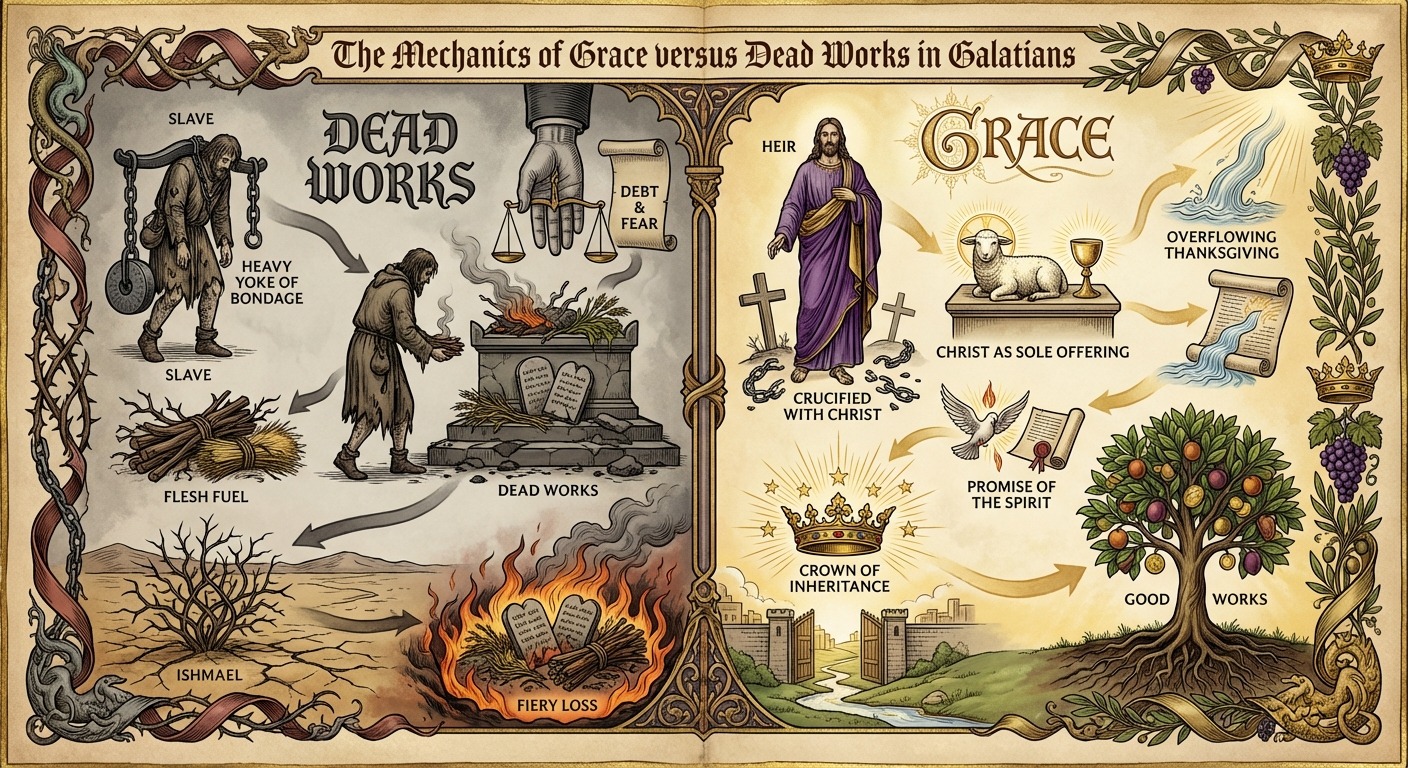
The system of dead works is portrayed as a heavy burden. Here, the individual is a Slave, bowed under an iron yoke of bondage, seeking to earn wages from God. The fuel for this effort is the Flesh, likened to dry wood, hay, and stubble—materials that have no lasting value. The slave brings forth dead works: withered sacrifices and crumbling stone tablets, all laid upon an altar in a desperate attempt to purchase favor.
The motive that drives this system is not love or gratitude, but debt and fear of a hard taskmaster. Such a motive cannot produce life. Instead, it bears "Ishmael," a symbol of barrenness and futility, pictured as a desert or a tangled thornbush. The end of this system is fiery loss; the works are consumed and reduced to ash, leaving nothing but smoke. As Paul warns, "Christ is become of no effect unto you, whosoever of you are justified by the law; ye are fallen from grace" (Galatians 5:4).
The System of Grace
In stark contrast stands the true system of grace. Here, the believer is not a slave but an Heir, a free son clothed in a royal robe. He stands upon a broken chain, signifying that he has been crucified with Christ and is dead to the law (Galatians 2:20). The heir does not bring his own efforts, but Christ Himself as the sole offering—a perfect lamb, a pure golden chalice.
The motive is not obligation, but overflowing thanksgiving for the free gift that has been received. The heir rests, ceasing from his own labors, and allows the Promise of the Spirit to operate. This promise is not earned, but inherited. From this place of rest, the Spirit produces a radiant crown of inheritance, and good works naturally overflow. These are not the dry, withered sacrifices of the flesh, but the fruit of a flourishing tree, deeply rooted and bearing rich fruit, increasing the eternal treasure.
The Clear Choice
Paul's message is clear: to return to the law and the flesh is to embrace a barren system that leads only to loss. To stand in grace is to receive the Spirit, to rest as an heir, and to bear fruit that endures. "Are ye so foolish? having begun in the Spirit, are ye now made perfect by the flesh?" (Galatians 3:3). The difference is not merely in outward action, but in the root: one system is driven by fear and debt, the other by thanksgiving and the Spirit's promise. Thus, the gospel calls the believer to reject the yoke of dead works and to rest in the freedom and fruitfulness of grace.
The Hagar-and-Sarah typology Paul will develop fully in chapter four is already visible here in seed form: the slave born of the flesh's effort, and the heir born of God's promise -- and the two cannot coexist in the same household of faith without one persecuting the other. Dead works cannot share a roof with the life of the Spirit; they will always move to crowd it out. This is not a theoretical danger for the Galatians -- it is already happening in real time. And the most dramatic evidence of the danger is not a doctrinal dispute but a mealtime scene at Antioch, where even Peter's behavior at the table began to say something that his theology denied. That is where the conflict becomes undeniable.
Understanding this fundamental contrast between the barren system of dead works and the fruitful system of grace prepares us to see why Paul reacts with such urgency to any distortion of the gospel. The next article will examine that specific threat: the perverted gospel that mixes grace with law-keeping, threatening to drag believers back into the very slavery from which Christ rescued them.
Every chart in this series is free to explore online.
 Get the full chart set (PDF – $8)
Members get all PDFs included → Why Membership
Log in with an active membership to download printable PDFs on this site. Purchased on the shop? Access downloads from your shop account.
If you would like to help fund this work:
These charts are based on the following book:

Galatians - Christ in Me As Life - the Spirit as the Blessing of the Gospel
A biblical commentary on Galatians, exploring how Christ is revealed throughout Scripture. Deep theological insights for serious students of the Word.
View Related Book